analysis·AI
Choosing the Right LLM: An Economic Perspective
The best model out there is not always required
·3 min read
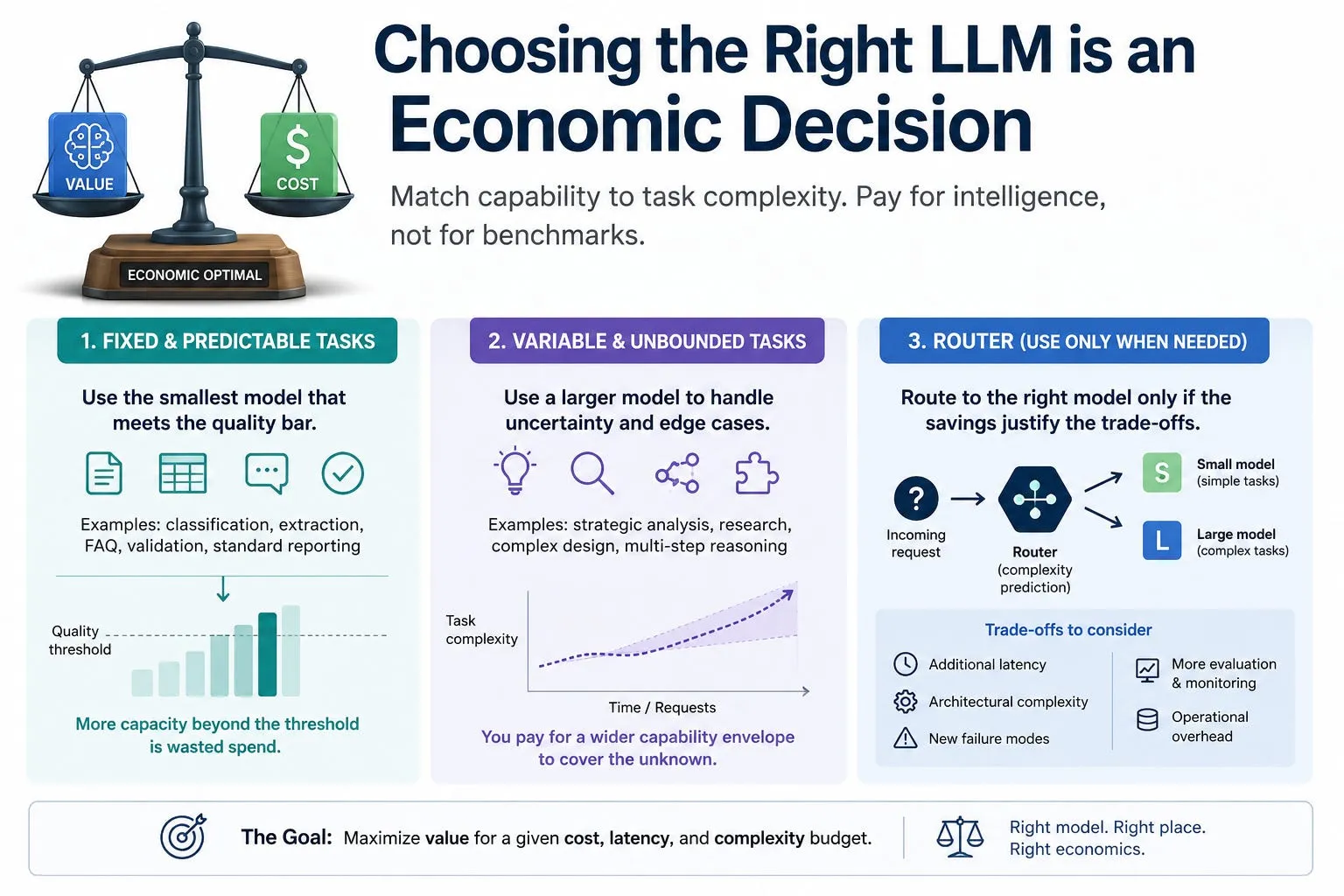
Most discussions about LLM selection focus on benchmark scores and capabilities. In practice, choosing the right LLM is an economic decision.
Every increase in model size comes with a higher inference expense, increased latency, and often greater operational overhead. The objective is not to maximise intelligence. It is to maximise business value for a given cost, latency, and complexity budget.
Match the Model to the Task
The first question is whether the task has a predictable complexity profile.
Many enterprise workloads are bounded and repetitive:
- Document classification
- Information extraction
- Customer support responses
- Report generation
- Data validation
For these use cases, the goal should be to identify the smallest model that reliably meets the required quality threshold. Once that threshold is achieved, additional capability delivers diminishing returns.
Using a frontier model for a simple extraction workflow is like hiring a management consultant to perform data entry. The capability exists, but most of it goes unused.
When Larger Models Make Sense
The economics change when task complexity is unbounded.
Consider activities such as:
- Strategic analysis
- Research synthesis
- Complex software design
- Multi-step reasoning
- Open-ended problem solving
In these scenarios, the next request may be significantly more difficult than the previous one. Because the upper bound of complexity is unknown, additional model capability acts as a buffer against uncertainty.
The larger model is not being purchased for average-case performance. It is being purchased for the difficult cases that smaller models may fail to handle.
The Model Router Question
A common alternative is to use a model router that dynamically selects between smaller and larger models.
On paper, this appears to offer the best of both worlds: low cost for simple tasks and high capability for difficult ones.
However, routing is not free.
A router introduces additional latency, architectural complexity, monitoring requirements, and new failure modes. The system must first determine how complex a task is before deciding which model should process it. If that decision is wrong, the expected savings quickly disappear.
For highly variable workloads, these trade-offs may be worthwhile.
But many enterprise agents do not operate in highly variable environments. Their responsibilities are typically well-defined: retrieve information, analyse documents, generate reports, invoke tools, and execute workflows. While the inputs may vary, the underlying task complexity often remains within a predictable range.
In such cases, a single well-chosen model is frequently simpler, faster, and more economical than a routing architecture.
A Simple Framework
When selecting an LLM, start with three questions:
-
Is the task complexity fixed and predictable? Choose the smallest model that reliably meets requirements.
-
Is the task complexity variable and difficult to bound? Consider a larger model to handle uncertainty.
-
Does the workload span multiple complexity levels at sufficient scale? Consider a model router, but only if the cost savings outweigh the added latency and operational complexity.
The goal is not to deploy the most intelligent model possible. It is to deploy the most economical architecture that consistently delivers the required outcome.
In AI, as in most engineering disciplines, the optimal solution is rarely the most powerful one. It is the one that delivers the required result with the least cost.
- #LLM
- #AI Economics
- #Model Selection
- #Cost Optimization